Обычная цена в Steam: 590 руб.
You never go on the adventure. You only decide who does.
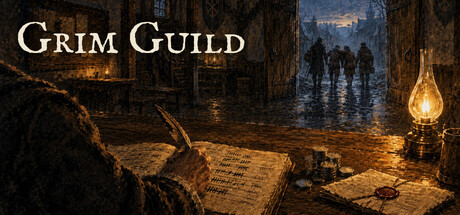
Your grandfather Karl left you an adventurers' guild and alehouse at the edge of Eldenmarch: a counter, a board, a bar, a hole in the roof, and a book full of the things he knew.
What is out there.
The road, the fen and the old quarry are full of things that take sheep, and sometimes people. Thunderboars and dire wolves, cave bears and wyverns, giant spiders, great worms under the fields, goblins, orcs and trolls, and once a year something with a name. The petitioner only knows that the stock is going missing. Send somebody to look first, and you will know what it is, and what it will take.
Petitioners make light of what a job asks, or keep it back. A creature with a name is strong from the start: each time it turns a group back, the town is hurt, and left alone it does not go away. Failures one after another bring orcs and goblins in numbers. When it is beyond the hall, the lord and the kingdom can be asked.
A week.
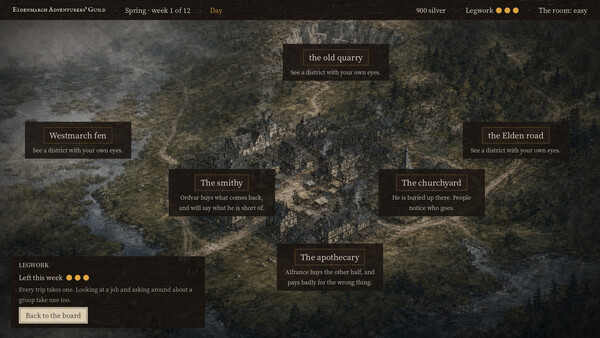
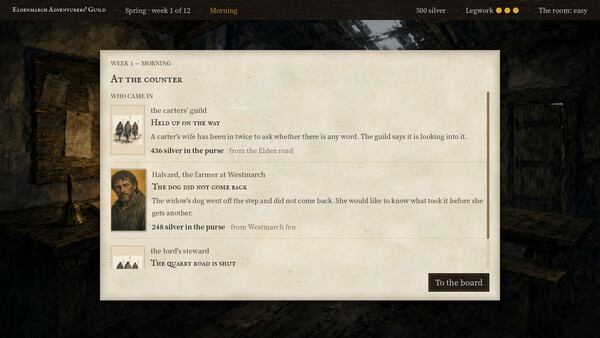
In the morning, whoever has come to the counter tells you what they need. By day you pin work to the board and spend your three errands for the week: look at a job before you post it, ask around about a group, or take the cart's haul into town while it still fetches a price. In the evening you stand at the door, and whoever is due back comes in. Or does not. At night you pour at the bar. Upstairs, there is the book, and the week's sums.
The sheet you write.
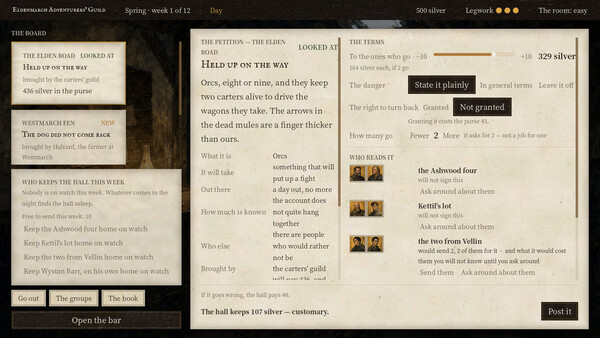
Every job goes out on a sheet in your hand. How much goes to them. How plainly you write the danger. Whether they may turn back. The sheet also says what the hall pays if it goes wrong. Nobody makes you tell the truth, and until somebody has looked, the board only knows what the petitioner said.
The people who sign it.
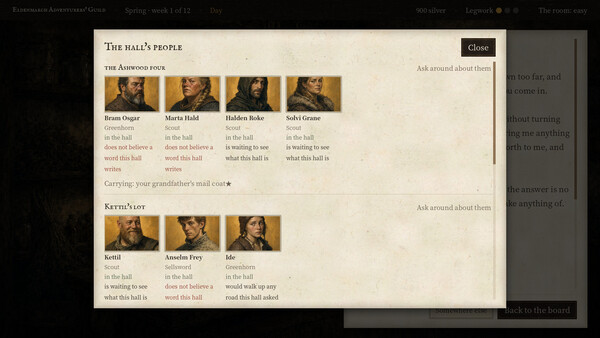
The groups on your bench read the sheet and decide whether to go. Write the danger plainly and grant the right to turn back, and they come to trust the hall. Leave the warning off, and the report that comes through the door will tell you what it cost, in words, because the fight is never shown. Every death can be traced back to a warning somebody chose not to write. A week somebody does not come back, the room goes quiet, and a quiet room does not sign. The churchyard helps, a little.
The name of anybody who does not come back is chalked on the wall by the door, then cut into the wood. Anybody sent without the danger written down is cut in red.
Ale takes a week at the least. Brew before the cellar runs dry.
Choose how hard it is.
Start at Gentle, Ordinary, Hard or Grim, in a town of any length, and lower it later if you need to. At Gentle and Ordinary you can go back to this week's morning, and a hall that goes under can begin again from the morning of that week. Hard and Grim have no way back.
Until the day ends.
Before a sheet goes up, a table says who goes, on what terms, what leaves the box now, what it brings if it goes well or costs if it goes wrong, and when you will know. Even once it is up, "Undo" at the top right takes it back until you end the day: the silver, the people and the sheet. What a look or a question taught you stays, and so does what you spent on it. What comes through the door in the evening stays too.
Karl's note, and the knock at night.
Karl left a note with the brewery. It falls due at the end of every season, more each time. What the box cannot meet goes on the brewery's slate, and the bar's takings go across to him until it is clear.
Some nights something knocks with no warning: a runner from a party that is out, a stranger bleeding on the step, a fire in the kitchen, somebody you turned away come back, a letter from home. You answer before morning, and either answer can come back the wrong way weeks later. Every precaution has a shadow, too. Careful people turn back early from work they could have done. Bandits kept off the hall go out on the road.
When the box runs short.
When the box holds less than two weeks' upkeep, "Silver" appears at the top right, with what is owed, what the yard would fetch, what can be cut and who would lend. The money-changer lends at interest. Miss the day and his man is at the door the next evening, and what is left comes out of the bar's silver every night and grows every week. Another hall lends with no interest, and two or three weeks later asks a favour. Each hall tells you which before you borrow, and you can pay it in silver instead. Refuse twice, and the hall's name falls hard and no hall lends to you that year.
Leave it to your staff.
When your hands are full, put people on the staff. The clerk decides which papers go up and which stay, the watch captain sends groups to the gate, on watch or on the rounds, the hiring hand takes on newcomers at the bar, and the accounts sell what is in the yard. The clerk's orders say what a failure must leave in the box, and whether they take on papers nobody has looked at, or dangerous work. Staff are paid every week. Left with neither a raise nor a bonus, those not sure of the hall go crooked. Another hall may take them, and after some years they leave.
The year, bound.
A year runs from spring to winter and the old quarry at the end of it. It ends in one of several ways, and what lies under the quarry is not the same in every town. However it ends, it is bound into a book with your name on the spine, to read again, print at A5, or send to someone else.
Keep the town alive.
The hall's work is to keep the town alive. A hall that goes under can open again; a town left empty is the end of it. In a town of many years you spend on a district's wall, ditch and keep, on guards, stores, help from outside and a share in the merchants' house. A town grown old brings works in stone and the town's great work, and from the thirtieth year a work in stone can be raised once more, to its finest. Send a group on the rounds, and it walks the most troubled district the hall still works; that week the trouble there settles a little. And the troubles come in as the years go on. A town of three years or more can be opened calm, ordinary or harsh.
A town nobody waits for.
Keep your hall in a town with up to a hundred others. Every hall starts in the town's first week and plays at its own pace. The halls ahead leave their marks on the weeks you have not reached: their dead are stones in your churchyard from the week they fell, their troubles are talk at your bar, and what they lost in the fens can turn up in your hands with a note of whose it was. Stand at another hall's stone and that hall hears of it. A town can last one year or fifty. Open it to your Steam friends only, to whoever has its six-character password, or to anyone looking down the street for a town: no address, no port. Your game keeps the town, and the others play on while you are away.
The name, and who comes after you.
The silver in the box is spent by the end of every year. The hall's name is what carries. A high name brings better hands to the door and bigger work to the board; a low one brings whoever has nowhere else to go. Some weeks you bet: brew winter ale for a festival that may not happen, lay in food against a famine that may not come, send someone after a creature that has a name. War, plague and flood come when they come. What you do afterwards is still yours. In a long town the keeper grows old, and after the twelfth year the hall passes to someone who once came in through the door.
No fight to play and no gore on screen. The deaths are in the reports, and they are yours.
When you are lost.
In the first week, Alfrance the apothecary lays a slip on each screen: what it is for, and which button goes on. The first time you meet a scene, the slip says what is happening, what comes of it if nothing changes, and what can be done. The next step is the dark button; ordinary choices are paper slips. On the board, a line above the post button says what stands against the job before it goes up. Beside a greyed button, "Why?" tells you the same. A button at the top of the board opens the job that would leave the most if it goes well, among those a free group would sign and has the hands for. It does not say the job is safe, so read it before you post it. "Try one spring (12 weeks)" on the title plays a single spring.
Your viewers bring the work.
Paste lines from your chat as "name: what they ask". At most one a week comes to the board, with that viewer as the one who brought it and their words on the paper. The work itself is the game's own. The night it comes home, the report opens with who asked.
Streaming and videos.
Stream it and post videos of it wherever you like, and monetize them with your platform's own features (ads, memberships, tips). You don't need to ask us. Clips and edits are fine too. Please put the game's name in the title or description. Please don't share the game's files, or sell its music on its own.
In Settings, "Streaming" makes the text larger and keeps the bottom-right corner clear for a camera. "Viewer names" gives your viewers' names to new adventurers. Give viewers the town's number and they can play the same town alone. Open the town to its password and read the password out, and viewers can keep their own halls in your town.
Every town deals a different cast and a different answer under the quarry, and the ending turns on how you play, so a stream rarely spoils anyone's own year. You can also share a town with friends, each keeping your own hall. Далее





Подпишитесь, и вы будете получать уведомления по электронной почте всякий раз, когда мы найдем более низкую цену на эту игру. От рассылки можно отписаться в любой момент. Категорически обещаем, что не будем рассылать спам, мы его сами не перевариваем.