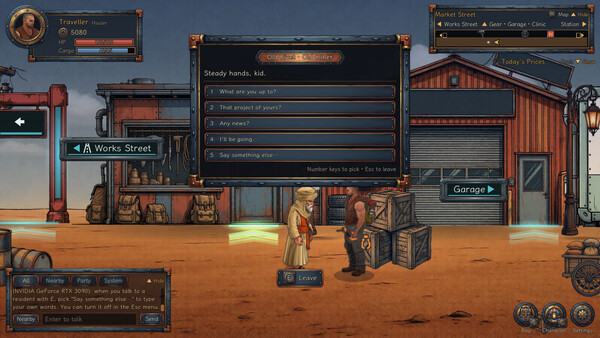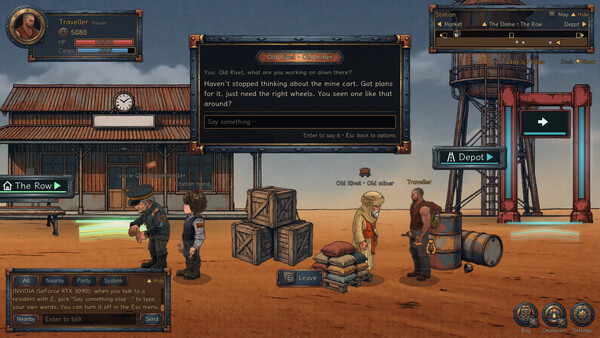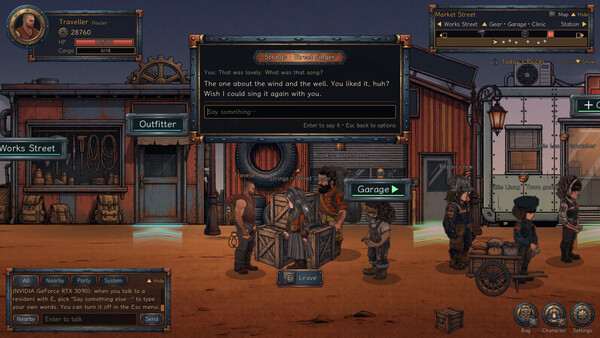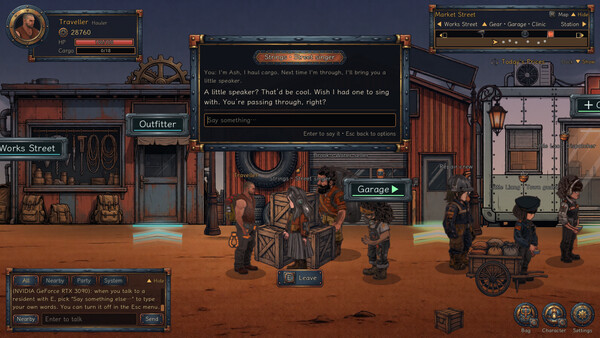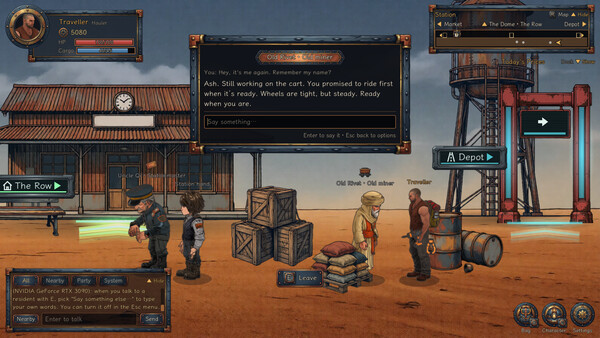
Type to the townsfolk. In the town, you usually talk to residents through a short list of options. With Resident Chat installed, the last line on that list is "Say something else…": pick it and type your own words. The resident answers as themselves — the old miner fixing his little cart, the singer on the market street — from what they did today, who they know in town, and what they think of you.They remember. When you leave, a resident keeps a few notes: your name, what you do, what you promised. Next time you meet, they bring it up.Two neighbours chatting in the street use it too.A resident has a few minutes for you. After a handful of exchanges they get back to work. Esc goes back to the options, and "I'll be going." ends it, same as always.It runs on your own PC. The replies come from a small language model (Qwen3-4B-Instruct-2507, through llama.cpp) running on your own graphics card. It runs only on your computer and closes together with the game, and there is no account to make: nothing you type is sent to any AI service; what residents remember is kept in your save, which goes to your own Steam Cloud if you have it on.It needs a dedicated graphics card with 8 GB of video memory, and 16 GB of RAM. If your PC can't run it, or you turn it off in the Esc menu, the residents talk through the usual options, and everything else plays the same.What it is, and isn't. Free, about 2.6 GB. Turn it on or off any time in the town's Esc menu ("Resident Chat (free DLC)"). Once it has downloaded, it starts without restarting the game.The residents stay in character. They steer away from real-world politics, religion and romance, and swearing or lines that break character are filtered out before you see them.A conversation can change how a resident feels about you, a little. It doesn't hand out items or money: in the town, a thing only counts when it is actually handed over.English and Simplified Chinese. It is a small model on a home graphics card, so now and then someone will misremember, or say something odd. Tell me when they do. Далее